
Mental health is a vital aspect of human well-being that affects every aspect of life, from personal relationships to social participation. However, mental health problems are often neglected, stigmatized, or misunderstood in many parts of the world, especially in low- and middle-income countries. The Philippines is one such country where mental health services are scarce, inadequate, and inaccessible for many people who need them.
According to the World Health Organization (WHO), the Philippines has one of the lowest ratios of mental health workers to the population in the world, with only 3.76 per 100,000 people. This means that there are not enough psychiatrists, psychologists, nurses, social workers, and other professionals who can provide quality care and support for people with mental, neurological, and substance use disorders. Moreover, most of the existing mental health facilities are concentrated in urban areas, leaving rural and remote communities underserved and marginalized.
The lack of mental health services has serious consequences for the health and well-being of Filipinos. The 2005 WHO World Health Survey in the Philippines identified that, of 10,075 participants, 0.4% had a diagnosis of schizophrenia and 14.5% had a diagnosis of depression. Of those with a diagnosis of schizophrenia, 33.2% had received treatment or screening in the past 2 weeks, compared with 14% of those with a diagnosis of depression. These figures indicate that many people with mental health problems do not receive adequate care or intervention, which can lead to worsening symptoms, disability, social isolation, and even suicide.
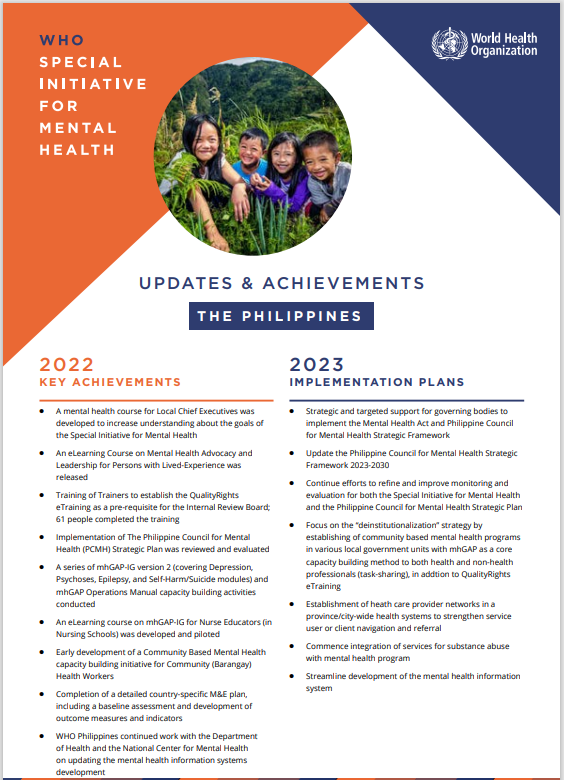
The situation is further exacerbated by the social and economic challenges that many Filipinos face, such as poverty, violence, natural disasters, and political instability. These factors can increase the risk of developing mental health problems or aggravate existing ones. For example, in Maguindanao province, where armed conflict has been ongoing for decades, the mental health needs of 1.4 million people are supported by very few community health workers with mental health expertise and only five specialized facilities. Through the WHO Special Initiative for Mental Health, nurses, midwives, and barangay health workers will be trained to address immediate gaps in mental health care.
This initiative is part of the broader efforts of the Philippine government and its partners to improve the mental health situation in the country. In 2017, President Rodrigo Duterte signed into law the Philippine Mental Health Act (Republic Act No. 11036), which aims to provide a comprehensive, integrated, and effective national mental health system that respects human rights and promotes wellness for all1. The law mandates the establishment of a national mental health policy and program that covers various aspects of mental health care, such as promotion, prevention, treatment, rehabilitation, recovery, and research.
One of the key components of the law is the integration of mental health services into primary health care settings. This means that mental health care will be made more accessible and affordable for people at the community level, where they can receive assessment, diagnosis, treatment, referral, and follow-up from general healthcare workers who are trained in basic mental health skills. This also means that mental health care will be more holistic and comprehensive, taking into account not only the biological aspects of mental disorders but also the psychosocial and environmental factors that affect them.
Mental health nursing is an essential part of this integrated approach to mental health care. Mental health nurses are registered nurses who have specialized training and experience in caring for people with mental health problems. They work in various settings such as hospitals, community-based clinics, rehabilitation centers, schools, workplaces, and homes. They perform a range of functions such as assessment, planning, implementation, evaluation, and coordination of care; psychoeducation, counseling, and therapy; medication management; crisis intervention; advocacy; and research.
Mental health nursing is a rewarding but challenging profession that requires not only clinical skills but also interpersonal skills, empathy, compassion, and resilience. Mental health nurses often face difficult situations such as stigma, discrimination, violence, and ethical dilemmas. They also need to cope with their own stress and burnout while providing care for others. Therefore, mental health nurses need to have adequate support and supervision from
their peers, mentors, and supervisors.
Mental health nursing education in the Philippines is also evolving to meet the changing needs and demands of society. There are various programs and courses that offer specialized training and knowledge in mental health and psychiatric nursing for nurses who want to pursue this field. For example, the University of the Philippines College of Nursing offers a Master of Arts in Nursing program with a Mental Health and Psychiatric Nursing track that aims to prepare students who have clinical expertise in the practice of mental health and psychiatric nursing for varied clientele in specialized settings. Graduates also perform research skills to address gaps in mental health and psychiatric nursing practice.
Mental health nursing is a growing need and opportunity in the Philippines. As the country strives to improve its mental health system and services, there is a greater demand for qualified and competent mental health nurses who can provide quality care and support for people with mental health problems. There is also a greater opportunity for mental health nurses to contribute to the development and implementation of mental health policies and programs, as well as to conduct research and innovation in this field. Mental health nursing is not only a profession but also a passion and a commitment to promote wellness for all.
The following infographic summarizes some of the key facts and figures about mental health in the Philippines
References:
WHO Special Initiative for Mental Health: Philippines. Retrieved from https://www.who.int/initiatives/who-special-initiative-for-mental-health/philippines : Mental Health Program
Department of Health website. Retrieved from https://doh.gov.ph/national-mental-health-program :
Mental health services in the Philippines – Cambridge Core. https://www.cambridge.org/core/journals/bjpsych-international/article/mental-health-services-in-the-philippines/539D09F6F7D56461A8653478FC63CAA1
MA Nursing – Mental Health and Psychiatric Nursing Track | UPCN – University of the Philippines College of Nursing https://upcn.upm.edu.ph/academic-programs/ma-nursing/ma-nursing-mental-health-and-psychiatric-nursing-track/
 Mindful Self-Care: Tips and Techniques for Better Mental Health