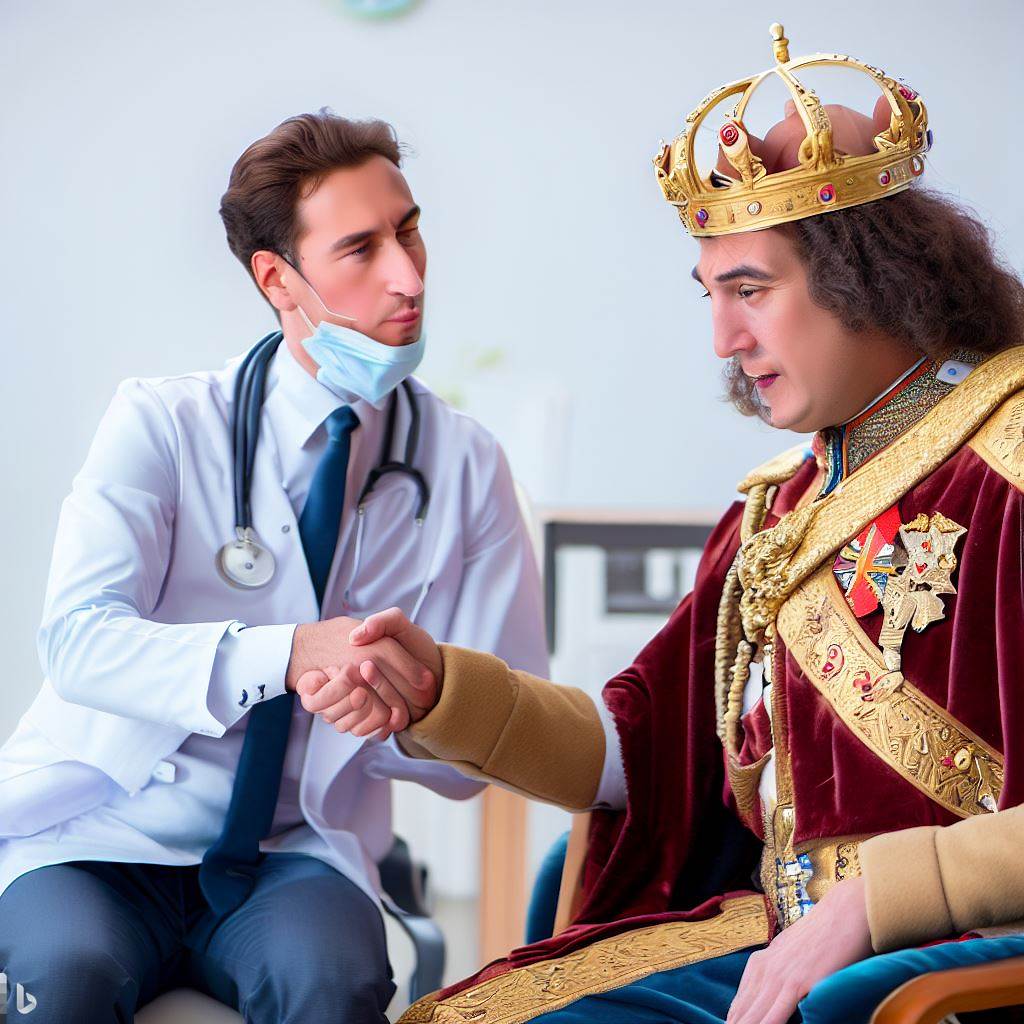
King George III is one of the most famous monarchs in British history. He ruled for 60 years, from 1760 to 1820, and oversaw the American Revolution, the French Revolution, and the Napoleonic Wars. He was also known as the “mad king” who lost America and suffered from recurrent episodes of mental illness that affected his ability to govern.
But what was the true nature of his condition? What caused his erratic behavior, his delusions, his speech problems, and his blue urine? And how did his illness impact his personal life and his legacy?

Theories and Controversies
For a long time, historians and doctors have debated the diagnosis of King George III’s mental illness. The most popular theory, proposed in the 1960s by psychiatrists Ida Macalpine and Richard Hunter, was that he had acute porphyria, a rare genetic disorder that affects the production of heme, a component of blood. Porphyria can cause symptoms such as abdominal pain, skin sensitivity, seizures, hallucinations, and dark or reddish urine1.
However, this theory has been challenged by recent research that analyzed thousands of King George III’s handwritten letters and found evidence of bipolar disorder, a mood disorder characterized by alternating periods of mania and depression23. Bipolar disorder can cause symptoms such as increased energy, racing thoughts, grandiosity, irritability, insomnia, and psychosis4.
Some researchers have also suggested that King George III’s medicine may have contributed to his blue urine. He was given gentian, a plant with blue flowers that is used as a tonic and may turn the urine blue2. Other factors that may have influenced his mental health include stress, grief, infection, and lead poisoning5
Personal and Political Consequences
King George III’s mental illness had a profound effect on his personal life and his political role. He had a loving marriage with Queen Charlotte and fathered 15 children, but he also endured the loss of several of them and the estrangement of others. He was devoted to his duties as king, but he also faced opposition from his ministers, his parliament, and his subjects. He was popular among the people for his domestic virtues and his support for agriculture and science, but he was also criticized for his stubbornness and his interference in foreign affairs.
His episodes of illness often forced him to withdraw from public life and delegate his authority to others. In 1788-89, he had a severe crisis that sparked a constitutional debate over who should act as regent in his absence. His eldest son, the Prince of Wales (later King George IV), was eager to take over, but he was opposed by the king’s loyal supporters and by Queen Charlotte. The Regency Bill was passed by parliament to grant the prince limited powers as regent, but it was never enacted because the king recovered before it received royal assent.
However, in 1810-11, the king had another relapse that lasted until his death in 1820. This time, the Prince of Wales became regent with full powers and ushered in a new era of social and cultural change known as the Regency. The king spent his last years in seclusion at Windsor Castle or Kew Palace, blind, deaf, and unaware of the events that were shaping his kingdom and the world.
Conclusion
King George III’s mental illness remains a fascinating topic for historians and medical experts alike. His condition has been variously attributed to porphyria, bipolar disorder, or other causes. His symptoms have been documented by his letters, his doctors’ reports, and his contemporaries’ accounts. His illness has been portrayed in books, plays, films, and TV shows. His illness has also shaped his personal life and his political legacy.
King George III was more than just a “mad king”. He was a complex human being who faced extraordinary challenges and left an indelible mark on history.
References:
(1) King George’s ‘Madness’ Illness in Queen Charlotte explained. https://www.townandcountrymag.com/leisure/arts-and-culture/a43688920/king-george-illness-queen-charlotte-true-story/.
(2) What was the truth about the madness of George III? – BBC News. https://www.bbc.com/news/magazine-22122407.
(3) The true story of King George III’s mental illness and his connection …. https://www.greatbritishlife.co.uk/people/22572945.true-story-king-george-iiis-mental-illness-connection-kew-palace/.
(4) The True Story Behind King George III’s Mental Illness. https://www.esquire.com/entertainment/tv/a43850727/king-george-illness-queen-charlotte-true-story/.
(5) What illness does King George have in Queen Charlotte: A … – GoodTo. https://www.goodto.com/entertainment/what-illness-does-king-george-have-in-bridgerton.
 Mindful Self-Care: Tips and Techniques for Better Mental Health